Rebuilding the Heart: 1ZZ-FE, a Supercharger and Water-Meth
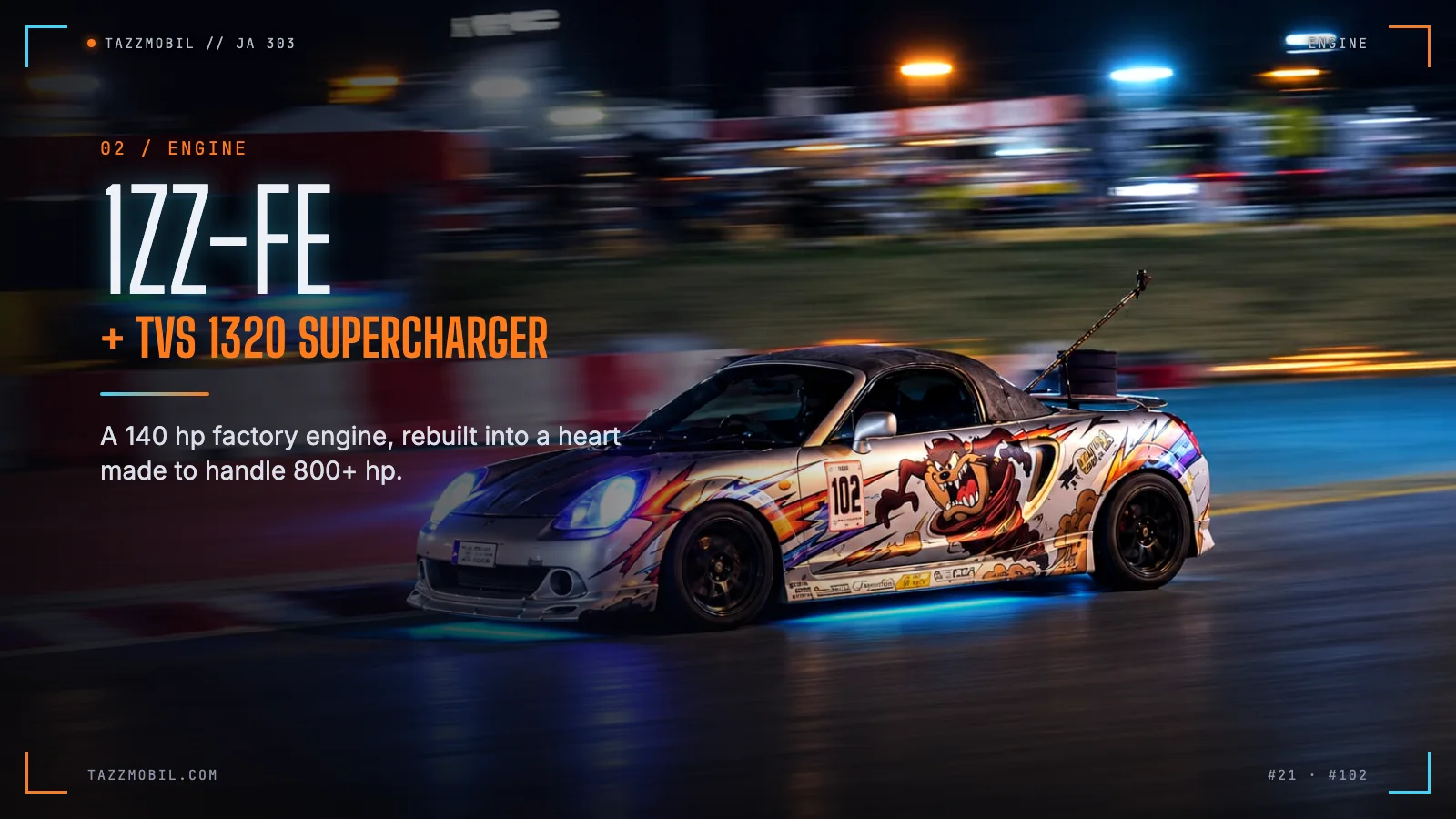
The first rule of putting big power into a light chassis: get the engine ready first. Tazzmobil’s heart is the MR2 Spyder’s factory 1.8-litre 1ZZ-FE. It makes 140 hp stock and is great for everyday driving — but it wasn’t designed to live with a supercharger’s boost.
Knowing the weak points
In Yusuf’s own account, the engine had two big weak points: the thin connecting rods and the aluminium block. Those are the parts the supercharger would stress first. So the work started by making the engine bulletproof, before adding any power.
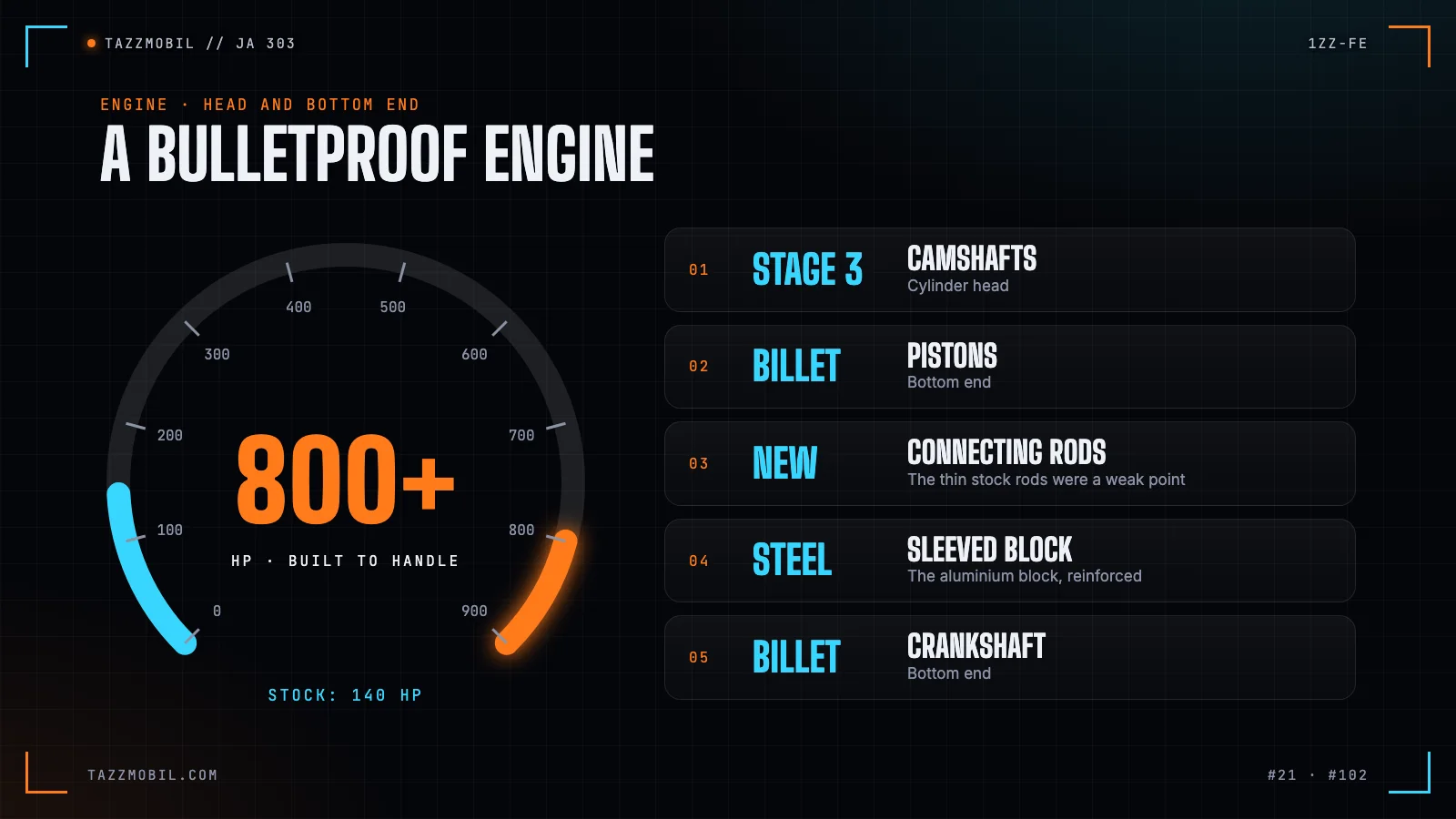
- Stage 3 camshafts
- Billet pistons
- New connecting rods, replacing the thin stock ones
- A steel-sleeved block: the aluminium block, reinforced with lightweight steel sleeves
- A billet crankshaft
The result is an engine built to handle 800+ hp. One distinction matters here: 800+ hp isn’t a power figure, it’s a strength limit. In a good build, what the engine can take always stays a step ahead of what it’s asked to make.
The supercharger: TVS 1320 Magnuson
For power, the choice was a TVS 1320 Magnuson supercharger. The full kit came from MWR in America, with a special intake manifold, throttle body and adapters to make it fit.
A supercharger like this is driven straight off the engine by a belt; unlike a turbo, it doesn’t wait for exhaust to spool it. Boost is there the moment you touch the throttle. In a small, nimble mid-engined car, that instant response means control.
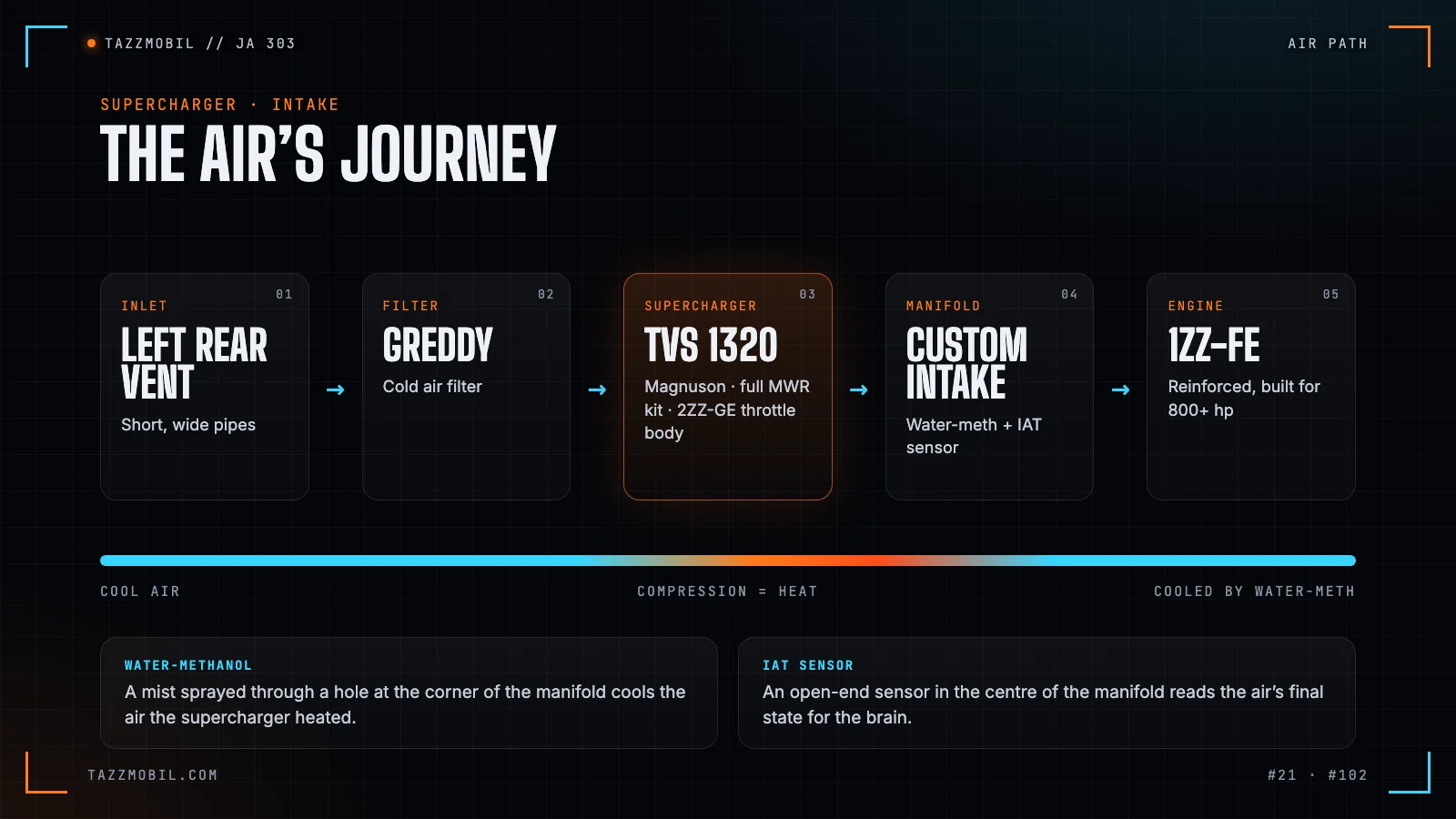
Three details stand out on the air side:
- Cool air. A Greddy cold air filter breathes through the left rear vent with short, wide pipes, so the air gets in easier and cooler.
- A 2ZZ-GE throttle body. The throttle body comes from the 2ZZ-GE, the sportier member of the same engine family. Air flows more freely and the response stays sharp.
- Water-meth and IAT. Compressing air heats it, and hot air both costs power and stresses the engine. A water-methanol mist, sprayed through a hole at the corner of the custom manifold, cools it down. A second hole, in the centre of the manifold, holds an open-end IAT sensor that reads the air’s final state on its way to the brain.
Feeding the machine
More air means more fuel — and flawless ignition.
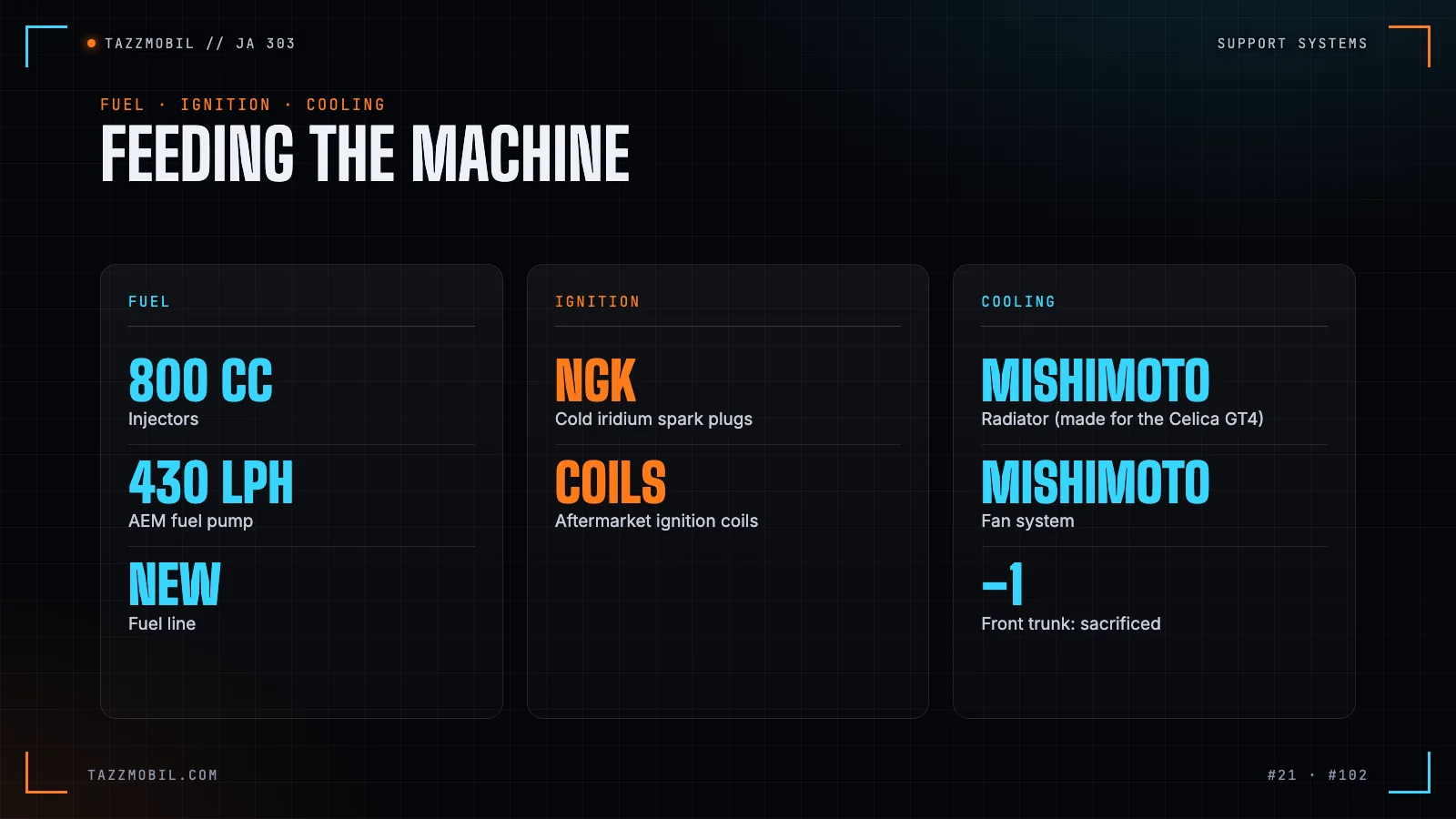
- Fuel: a new fuel line, 800 cc injectors and an AEM 430 lph pump for smooth delivery.
- Ignition: cold iridium NGK spark plugs and aftermarket ignition coils. Under boost, a colder plug is extra insurance.
- Cooling: the engine’s other weak point. A Mishimoto radiator and fan system made for the legendary Celica GT4 went in. The price: the front trunk is gone.
The result
An engine that left the factory with 140 hp, rethought part by part into something else entirely. To see the result from the cockpit, watch the 60–160 km/h run on the car page — and turn the sound up.
Next in the series: Putting the power down: the E153 gearbox and a Cusco-braced chassis. Back to the start: A mid-engined legend: the MR2 story.
Source: Yusuf’s own build write-up on r/GarajTurkiye.